Digital Marketing Statistics: Every Marketer Needs to Know in 2025

In the fast-paced world of digital marketing, data isn’t just a tool; it’s the compass guiding every decision. Whether you’re a seasoned marketer, a business owner, or fascinated by online promotion, understanding the latest digital marketing statistics is your key to staying ahead of the curve. In 2025, where trends shift faster than ever, data-driven strategies have become essential for optimizing campaigns, engaging audiences, and driving measurable results.
Why Data-Driven Strategies Matter?
- Data illuminates consumer behavior, enabling marketers to anticipate needs and tailor campaigns accordingly.
- With 87% of marketers saying that data-driven decisions improve ROI, it’s evident that insights are the key to staying ahead.
- Statistics help identify trends, avoid pitfalls, and prioritize efforts where they matter most.
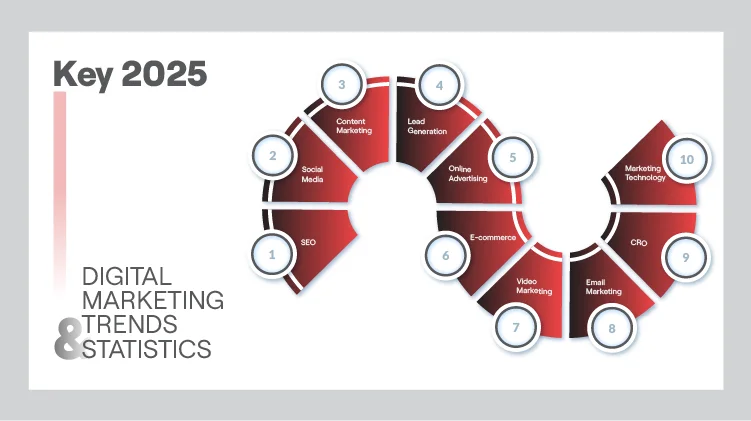
Key 2025 Digital Marketing Trends and Statistics
Why Are Digital Marketing Statistics Important?
1. Informed Decision-Making
Statistics offer insights into what works and what doesn’t, enabling marketers to make data-driven decisions. By analyzing metrics such as click-through rates (CTR), engagement, and conversions, businesses can:
- Identify high-performing channels.
- Allocate resources effectively.
- Avoid strategies that yield low ROI.
Example: If 81% of marketers find short-form videos the most engaging format, it’s clear that prioritizing platforms like TikTok or Instagram Reels can yield better results
2. Optimizing Campaign Performance
Digital marketing campaigns thrive on continuous improvement. Statistics help:
- Track key performance indicators (KPIs) like ROI and CTR.
- Test and refine strategies through A/B testing.
- Understand audience preferences for better targeting.
Example: Segmenting email campaigns has been shown to increase revenue by 760%. Knowing this allows marketers to focus on personalization and segmentation to boost results.
Staying Ahead of Trends
The digital marketing landscape is changing rapidly. Keeping up with the latest statistics helps marketers adapt to emerging trends and remain competitive.
- Trend Spotting: Statistics highlight shifts in consumer behavior, such as the growing dominance of mobile commerce or the popularity of video marketing.
- Competitive Edge: Understanding where the industry is headed allows businesses to innovate before their competitors do.
Example: With 58% of searches conducted via voice assistants, brands need to adapt their SEO strategies to prioritize voice search optimization.
Enhancing Customer Experience
Statistics reveal consumer preferences and behaviors, enabling marketers to create more personalized experiences.
- Predictive analytics tools, for instance, improve campaign success rates by 43%, helping brands anticipate what customers want.
- Interactive content, like polls or quizzes, generates 2x more engagement, offering a more dynamic and enjoyable customer journey.
Social Media Marketing Statistics
Social media statistics offer a clear picture of where audiences are most active and engaged, providing valuable insights for marketers looking to target the right platforms. As of 2025, platforms like Instagram and TikTok continue to lead with massive active user bases, with Instagram boasting over 2 billion monthly active users and TikTok nearing 2 billion as well.
Facebook, while still dominant in terms of total users, has seen engagement rates slightly plateau as younger demographics gravitate towards newer platforms. Engagement rates vary significantly depending on content type. For instance, video content tends to dominate, with platforms like TikTok and Instagram seeing higher engagement rates for short-form videos, followed by carousel posts and stories. Marketers are also noticing shifts in how brands allocate budgets on social platforms.
As user behavior evolves, there’s a growing trend in increased ad spending on TikTok, while platforms like Facebook and Instagram still command a significant share of ad dollars, but with a stronger focus on video ads and influencer partnerships. These statistics reveal not only where audiences are spending their time but also the type of content that drives engagement, helping marketers refine their strategies to stay ahead in an increasingly dynamic landscape.
Also Read : Best Social Media Marketing platforms for Mobile Apps
Email Marketing: The ROI Powerhouse

Email marketing continues to be a high-performing channel with strong ROI across industries. On average, email open rates range from 15% to 25%, depending on the industry, while click-through rates (CTR) can range from 2% to 5%. Personalization significantly boosts engagement—emails that are tailored to the recipient’s preferences see 26% higher open rates and 41% higher click-through rates. Automation and segmentation further increase ROI, with segmented campaigns driving 760% higher revenue compared to non-segmented efforts. These stats sho
SEO and Organic Search
Organic search is a major driver of website traffic, with 53% of all website traffic coming from organic search results. The top-ranking results on Google typically receive 31% of clicks, with the first position getting around 25% of total clicks. As voice search and mobile usage grow, voice searches are projected to account for 50% of all searches by 2025, pushing the need for voice-optimized content. Additionally, mobile-first indexing is crucial as mobile searches now account for 60% of total searches, making mobile optimization key for ranking success.
Online Advertising: Stats for Maximizing ROI
Online advertising continues to evolve, with key metrics showing shifts in how businesses allocate budgets. Average cost-per-click (CPC) varies by industry, with sectors like legal services seeing higher CPCs (around $6.75 per click), while retail has a lower CPC of around $1.15 per click. Google Ads outperforms social media ads in conversion rates, with Google Ads showing an average conversion rate of 4.4%, compared to 0.9% on social media platforms. The rise of programmatic advertising, which automates ad buying and targeting, has transformed PPC, making ads more targeted and cost-effective, resulting in a 10-30% increase in ad performance for many brands.
Content Marketing
Quality content remains a cornerstone of successful digital marketing. Long-form content (over 2,000 words) not only drives higher engagement but also contributes significantly to higher search engine rankings, with pages of this length ranking 77% better on search engines. Video content is also a major player, with people consuming over 100 million hours of video content on Facebook alone each day, and video ads achieving 49% higher click-through rates than static ads. Blog frequency is another key factor, with businesses that publish 16+ blog posts per month seeing 3.5 times more traffic and 4.5 times more leads than those that post less frequently
Marketing Technology
The growth of marketing technology (MarTech) continues to revolutionize how businesses engage with customers. In 2025, 75% of marketers report using artificial intelligence (AI) tools for customer segmentation, personalization, and predictive analytics. The ability to leverage big data and machine learning to predict consumer behavior and optimize campaigns in real time is becoming increasingly important. MarTech stacks are also evolving, with 45% of businesses integrating Customer Data Platforms (CDPs) to centralize data and improve campaign targeting.
E-commerce and Conversion Optimization
Cart abandonment rates remain high at 69.8% across industries, but implementing email recovery campaigns and offering personalized incentives can reduce this rate by 15-20%. Website speed plays a significant role in conversions, with sites that load in 2 seconds or less experiencing a 32% higher conversion rate compared to slower-loading sites. Personalization, such as showing tailored product recommendations, can drive 25% higher revenue per customer, making it an essential strategy for increasing e-commerce conversions.
Conclusion
In 2025, digital marketing continues to be a dynamic and rapidly changing landscape, driven by technological advancements, evolving consumer behaviors, and innovative strategies. The statistics highlighted in key areas of email marketing, SEO, online advertising, content marketing, e-commerce, and emerging technologies underscore the importance of data-driven decisions. Marketers who understand these trends can optimize campaigns, drive higher ROI, and stay ahead of the competition.
Whether it’s personalizing email content to boost engagement, leveraging long-form content to enhance SEO rankings, or adopting AI and AR to create more immersive customer experiences, the right use of statistics empowers businesses to make smarter, more informed choices. As digital marketing evolves, staying up-to-date with the latest metrics and adapting strategies accordingly will be the key to success in 2025 and beyond.
By continually analyzing and adjusting your approach based on these powerful insights, you’ll not only improve campaign performance but also build a stronger, more resilient towards digital marketing strategy for the future.